


Maramec Spring Park Trout Fishing Near St. James: Rainbow & Brown Trout

No AI was used or harmed to create this story and imagery.
Just outside St. James, a private stretch of ground holds one of the state’s clearest springs—pumping out 100 million gallons daily. It is the fifth-largest spring in Missouri, and the flow stays cold and steady year-round—typically in the mid-50s Fahrenheit—which is why the Missouri Department of Conservation (MDC) has a symbiotic relationship with The James Foundation, which owns the private Maramec Spring Park.

You pay $7 a car at the gate and the rest of the day is yours—picnic tables, short trails, the old ironworks ruins, and the cold water that comes up out of the rock and never warms much past the mid-fifties—and fish love that. For additional fees, you can enjoy trout fishing at the Maramec Spring Park!

A walk around the spring may be one of the best walks I have ever taken.


The mouth of the spring.

...one of the state’s clearest springs—pumping out 100 million gallons daily.

I am always fascinated by reflections.


An adult eagle did a flyby during my walk—that was worth the 7 bucks right there.

Lucy Wortham James established Maramec Spring Park, which she regarded as the most beautiful spot in Missouri. It became a park in 1939.


How can there be so many great images in a 15 minute walk?


The spring itself is private property, but the fish that live in it are public property.

Every morning during the regular season, the hatchery crew loads the day’s allotment and releases them out to the spring branch—that keeps the fishermen very happy.
That water is the reason the Missouri Department of Conservation keeps a trout hatchery on the property. The spring itself is private ground, but the fish that live in it are public property. MDC raises rainbow trout right here at the mouth of the spring. Naturalists move the fish through the life stages like farmers move livestock: from eggs to fry to fingerlings to release size. Every morning during the regular season, the hatchery crew loads the day’s allotment and releases them out to the spring branch.

...state hatchery that keeps the cold water stocked so the people who show up still have something worth casting for.
Fishermen buy a daily trout tag at the same building where they paid the car fee. Kids walk along the raceway with cups of feed and watch the trout boil up. The whole place runs on that simple arrangement: a private park that charges a modest gate fee, and a state hatchery that keeps the cold water stocked so the people who show up still have something worth casting for.
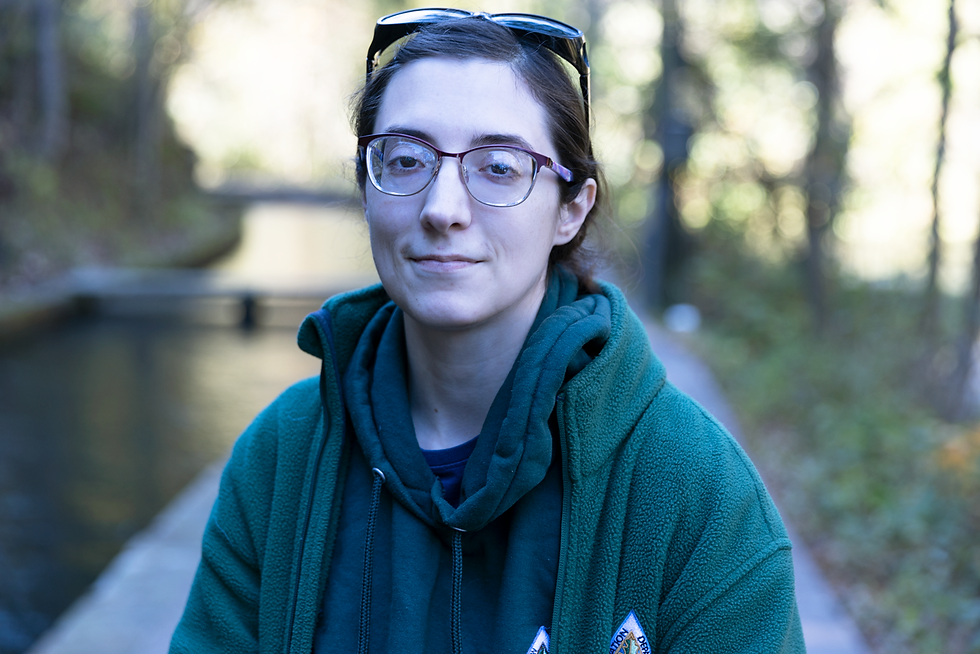
Conservationist Jennifer Edwards told us, Nearly all of them are rainbow trout. A smaller number of brown trout are also stocked there. Rainbows have no size limit to keep; brown trout must be at least 15 inches. Most of the stocked fish are around 8 inches long or bigger when they go into the water. Lunkers (bigger fish, often defined as 18 inches or 3+ pounds) are mixed in on heavier stocking days—even with a net, the fish are hard to catch.

Jennifer caught a few of the slippery beasts for show-and-tell.

The Rainbow Trout is a pretty fish.

The Brown Trout is pretty, too.
On a regular day during the main season, the park stocks roughly two fish per estimated angler. Opening day is heavier—recent openers have seen around 4,000–5,000 trout put in the spring branch, including a few dozen lunkers—about 50,000 trout a year at the Maramec Spring.


These holding tanks are called raceways. They’re called raceways because they’re long, narrow channels designed so water flows (or “races”) continuously from one end to the other.

A gazillion fish! At Maramec, the raceways are fed directly by the cold spring, which is why the setup works so well for rainbow and brown trout production.

It takes a ton of work to keep 100,000 hungry fish healthy and happy.
Releasing happens daily from March 1 through October 31 (the catch-and-keep season). The fish are typically released into the spring branch overnight or early in the morning so they are ready to fight when the fishing day begins (announced by a siren). From roughly the second Friday in November through the second Monday in February, the park switches to catch-and-release only (flies only).

You still need a Missouri fishing permit (unless exempt) plus a daily trout tag ($5 adult / $3 youth 15 and under) to fish during the main season. The daily limit is four trout, and the possession limit is eight.


The remains of the Maramec Iron Works (1826–1876)
In 1826, Thomas James and his partner Samuel Massey established the Maramec Iron Works at the spring. The furnace was completed around 1829, making it the first successful ironworks west of the Mississippi. The operation used the spring’s powerful flow for waterpower, charcoal from local forests, and high-grade hematite from a nearby open-pit mine. It produced tools, household goods, and other iron products for frontier settlement and later supplied iron for Union needs during the Civil War (including for cannonballs and James B. Eads’ gunboats in St. Louis).

Get Out There!
The combination of a major Ozark spring, cold-water trout management, industrial history, and scenic setting makes it a classic Missouri natural and recreational spot — very much in line with the region’s spring and river character.
It is not the biggest spring in Missouri, and it is not a state park. It is just a super beautiful place where the water stays cold, and the fish keep coming, one load at a time.
Learn more at: https://maramecspringpark.com/
Now, GET OUT THERE!
Take a hike. Start a business. Take a day trip. Catch a fish. Do anything. Do something. Get out there, that sunken sofa won't miss you—time's a-wasting!
—Pics & Words by T. Smugala.


Be sure to visit all of our awesome sponsors who make these stories possible!


